
Letters of Credit
How Letters of Credit Shape Global Supply Chains: The Unseen Architecture Behind International Trade
Author: Manyi Kiss Publication Date: December 4, 2025 Reading Time: 4 minutes --- Modern supply chains depend on logistics, technology, and operational efficiency, yet their foundation rests on a critical financial mechanism: the Letter of Credit LC. Though often invisible to ou
Manyi Kiss · · 4 min read
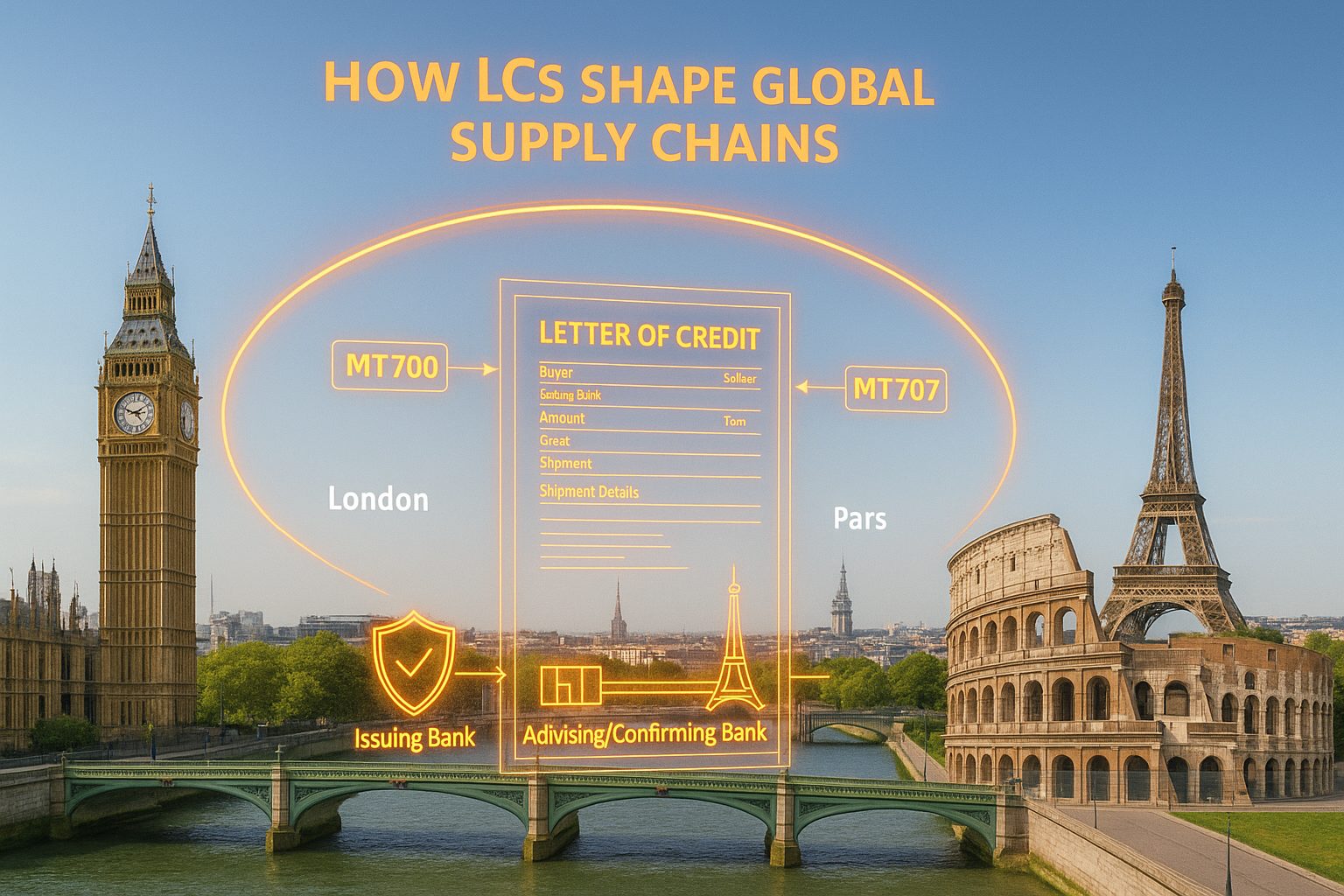
How Letters of Credit Shape Global Supply Chains: The Unseen Architecture Behind International Trade
Author: Manyi Kiss Publication Date: December 4, 2025 Reading Time: 4 minutes
Modern supply chains depend on logistics, technology, and operational efficiency, yet their foundation rests on a critical financial mechanism: the Letter of Credit (LC). Though often invisible to outside observers, this instrument remains essential for enabling trust, continuity, and risk management across international borders.
Behind every shipment of raw materials, machinery, electronics, pharmaceuticals, or industrial components lies a Letter of Credit that orchestrates value exchange between parties who may never meet, operate under different legal systems, or face geopolitical separation. The LC functions as institutional glue binding global supply chains together.
Letters of Credit as the Financial Infrastructure of Global Supply Chains
Letters of Credit succeed where contracts alone cannot. In cross-border operations, legal enforcement moves slowly, jurisdictional risk runs high, and counterparties rarely depend on goodwill. Instead, companies rely on "the institutional guarantee embedded in an LC issued and confirmed through the global SWIFT network."
An LC ensures:
• the seller ships goods with payment assurance • the buyer pays only if compliant goods are shipped • both parties reduce exposure to counterparty failure • trade continues smoothly across borders and risk zones
In today's fragmented and uncertain world, this mechanism remains increasingly relevant.
The SWIFT Backbone: How Letters of Credit Move Across Borders
Every Letter of Credit operates through "a series of SWIFT messages that build its structure, enforce its rules, and ensure its legitimacy." These standardized, globally recognized protocols define international trade finance.
Key SWIFT messages for LCs include:
MT700 – Issue of a Documentary Letter of Credit The cornerstone message containing full terms, conditions, required documents, expiry, shipment period, and amount.
MT701 – Issue of LC (Additional Conditions) Used when LC terms require extended fields or complex documentation.
MT707 – Amendment to a Letter of Credit Allows modifications such as extending shipment deadlines, adjusting amounts, or altering documentation requirements.
MT710 – Advise of a Documentary Credit Sent by the advising bank to notify the beneficiary of LC issuance.
MT720 – Transfer of a Documentary Credit Essential for transferable LCs used in multi-layer supply chains or intermediary procurement.
MT799 – Free Format Message Used for communication between banks, often for pre-verification, clarifications, or readiness confirmation prior to LC issuance.
This SWIFT architecture standardizes trust, ensuring that an LC received in Hong Kong carries identical meaning in Dubai, Milan, Singapore, or São Paulo.
Why Supply Chains Depend on Letters of Credit
Mitigating geopolitical and commercial risk When supply chains operate across politically unstable regions or emerging markets, LCs function as institutional risk buffers.
Enabling production continuity Manufacturers depend on timely component delivery. LCs guarantee that suppliers possess both incentive and financial security to deliver.
Supporting complex, multi-tier networks Tier-1 suppliers often rely on LCs to manage payments to tier-2 and tier-3 operators, using transferable or back-to-back structures.
Allowing companies to scale globally LCs create frameworks enabling mid-sized companies to transact internationally with global corporate professionalism.
Providing enforcement in decentralized ecosystems In global supply chains, enforcing contracts across jurisdictions often proves impractical. LCs provide institutional accountability without requiring courts.
The Invisible yet Critical Role of LC Confirmation
In high-risk jurisdictions, suppliers often request a confirmed Letter of Credit, meaning a second institution—typically based in a stable financial center—adds its own payment guarantee.
Confirmation depends on strategic decisions based on:
• country risk • issuing bank credibility • compliance environment • shipment value and sensitivity • counterparty reliability
Credit Glorious supports companies by advising whether confirmation is required and by facilitating LC-based assurance in complex cross-border operations.
Smarter Supply Chains Use LCs as Strategic Tools
Modern corporates increasingly treat Letters of Credit as "strategic enablers, not just payment mechanisms."
They use LCs to:
• negotiate better terms with new suppliers • unlock larger procurement capacity • secure production slots in competitive industries • strengthen negotiating power in long-term contracts • protect working capital from unexpected disruptions
In an era where supply chains determine competitiveness, the LC has become "a form of financial infrastructure, as essential as logistics or technology."
Why Institutions Like Credit Glorious Matter
Letters of Credit are not commodities. Their value depends entirely on:
• the institution issuing them • the institution confirming or advising them • the operational accuracy of SWIFT drafting • compliance standards • the ability to support counterparties across jurisdictions
Credit Glorious's institutional-grade experience in trade finance and cross-border operations provides companies with clarity, credibility, and structured support in LC-based transactions.
FAQ — Letters of Credit in Global Supply Chains
Why are Letters of Credit still essential today? Because they provide institutional trust in environments where contractual enforcement is slow or unreliable.
Which SWIFT messages define an LC? Primarily MT700, MT701, MT707, MT710, MT720, and MT799.
Why do supply chains depend on LCs? Because they reduce counterparty risk, ensure compliant shipment, and stabilize cross-border procurement.
What is LC confirmation? A second institution guaranteeing payment, used in higher-risk jurisdictions.
Are LCs still growing in relevance? Yes—especially in manufacturing, energy, logistics, infrastructure, and technology supply chains.
Book a Call with Credit Glorious
1 hour consultation available. [Book Now]